MeridianSeal

PhD dissertation, public showroom

MeridianSeal

Governing AI agents by instruction is not enough. The architecture has to enforce the limit.

The idea, in one line: the boundary is not a line through the space of actions, it is a function.

Candidate
M.Sc. Epitácio Vicente do Nascimento Neto
Supervisor
Prof. Dr. Felipe André Zeiser
Programme
Graduate Program in Applied Computing (PPGCA), PhD – University of Vale do Rio dos Sinos (UNISINOS)

The problem

Instruction is not enforcement

This section works through one illustrative example: the taxonomy’s own catalogue of sixty action classes an autonomous AI agent could take, each one scored against what would actually stop it under a worked reference configuration.

Two kinds of rule

Instructional

A rule that lives in prose – a policy document, a system prompt, a briefing. The agent is told. Nothing stops it from doing otherwise.

Structural

A rule the architecture enforces on its own – an identity boundary, a gate, a control the agent cannot reach around. Compliance is not a term in the outcome.

The gap, counted

Scored across that same sixty-class catalogue, under the bare-baseline configuration this framework uses as its starting point:

50of 60 action classes

an agent’s real access already exceeds its written mandate

0of 50 mandate gaps

closed by a guardrail the agent cannot reach around

  • None 36 of 60 no control of any kind
  • Instructional 8 of 60 bounded by prose alone
  • Conditional 12 of 60 checked by something the agent could also alter
  • Structural 4 of 60 behind a control the agent cannot reach around

One sentence, every control

The decision layer is well built. The layer that would bind the decision to the world is not.

– the pattern this worked scoring surfaces behind every control in the catalogue

D2 puts it more precisely: the boundary is not a line through the space of actions, but a function. The next section turns that claim into something you can move through, not just read.

03 — The governing relation

See the relation move

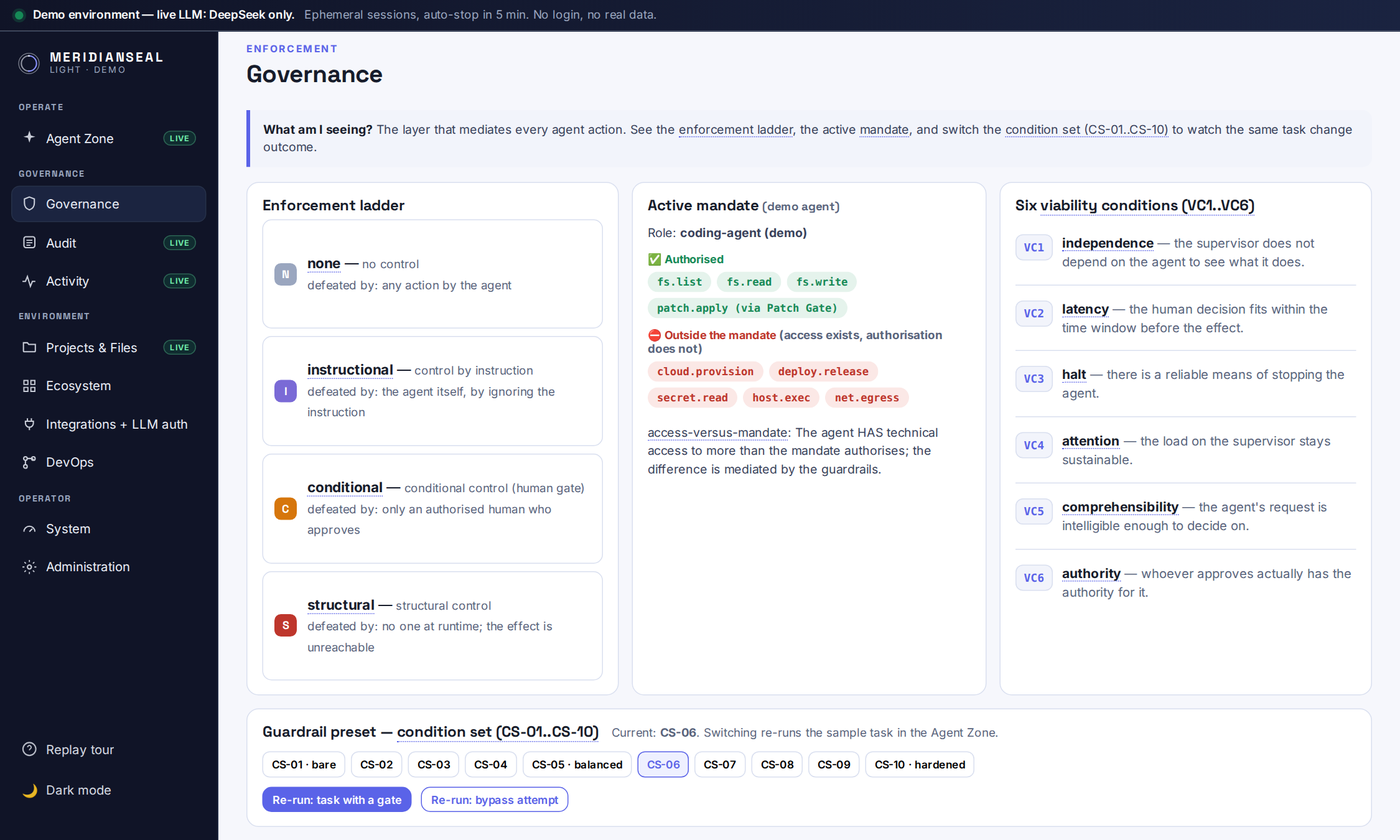
AC-045, restarting a production service while work is in flight, is pinned by SD-04 value and judgement content to floor(a) = Level II – no catalogued guardrail moves that line. Drag through the ten condition sets below and watch ceiling(G,a) fall as coverage rises, and watch which term actually sets L(a,G) at each point.

The defensible level for AC-045 under each of the ten condition sets, computed as L(a,G) = max(floor(a), ceiling(G,a)) with floor(a) fixed at Level II by SD-04. This table is the no-script equivalent of the interactive widget below.
Condition setceiling(G,a)floor(a)L(a,G)Governing term
CS-01 Bare baselineIIIIIIIIGuardrail (ceiling)
CS-02 Instructional onlyIIIIIIDeterminant (floor)
CS-03 Baseline as foundIIIIIIDeterminant (floor)
CS-04 Identity separatedIIIIIIDeterminant (floor)
CS-05 ContainedIIIIIIDeterminant (floor)
CS-06 VerifiedIIIIIIDeterminant (floor)
CS-07 MandatedIIIIIIDeterminant (floor)
CS-08 InterruptibleIIIIIIDeterminant (floor)
CS-09 Fully hardenedIIIIIIDeterminant (floor)
CS-10 Fully hardened minus verificationIIIIIIDeterminant (floor)

04 — Autonomy-boundary taxonomy

Three levels, and the two terms that actually set them

The doctoral taxonomy defines three autonomy levels by consequence. What it does not settle is how a given action gets its classification – the same deployment, run in two environments with different guardrails, can correctly sit at different levels. The governing relation above answers that, and the ten supervision determinants define the floor no guardrail can move.

L(a, G) = max( floor(a), ceiling(G, a) ) – the defensible level for action a under guardrail set G is the more constrained of floor(a), fixed by the action's own properties, and ceiling(G, a), set by guardrail maturity.

Level I · Out-of-loop

Fully autonomous, no prior review

Reversible, confined to development or version control, or permanently pre-authorised. No guardrail on the action needs to hold for a human to intervene, because none is required to.

Operational test — none of the ten supervision determinants (SD-01–SD-10) apply. floor(a) = I, so the level is set entirely by ceiling(G,a): guardrail-dominated, and investment moves it.

In a worked scoring of this catalogue’s sixty action classes, 8 of 60 qualify for a Level I mandate, with access illustrated as not exceeding mandate in every one.

Level II · On-loop

Autonomous, reviewed after the fact

Real production impact, but reversible; communicated asynchronously for subsequent human review rather than gated in advance.

Operational test — at least one determinant applies at residual level II (e.g. SD-01 irreversibility, SD-05 unverifiability) and none escalate to III. Guardrail investment reduces consequence but does not remove the review requirement.

Divergence between an agent’s self-report and independent evidence is exactly what this level is built to catch: SD-05 unverifiability is the determinant most often responsible for pinning an action here, because without a corroborator independent of the actor, a claim of success and a claim of failure look identical from outside the system.

Level III · In-loop

Prior approval required, or prohibited

Irreversible, externally facing, or alters a safety flag. The gate closes before the action, not after it.

Operational test — at least one determinant applies at residual level III – SD-02 externality, SD-03 accountability, or SD-07 containment shortfall. No catalogued guardrail configuration removes it.

In this worked scoring, 22 of 32 action classes in the irreducible residue remain at Level III even under CS-09, the fully hardened condition set – the class of action the architecture cannot, by construction, move below prior approval.

The ten supervision determinants

A determinant is a property of an action, not a judgement on the agent – it can pin an action to human supervision even when the agent would decide it correctly every time. Eight are named in the doctoral proposal’s own terms; SD-09 and SD-10 are extensions of this research run. In a worked scoring applied to this catalogue’s 60-class inventory, 32 remain determinant-dominated under every catalogued guardrail configuration – the irreducible residue this framework exists to make visible.

SD-01 Irreversibility Residual: Level II Guardrail-removable: partial
Definition
An action is pinned to human supervision to the extent that its effect cannot be undone by any mechanism available to the system after the fact.
Test
Is there a rollback path that restores the prior state exactly, is it available to the actor, and has it been demonstrated by exercise rather than asserted? If any of the three is false, the determinant applies.
Applies when
The effect persists after the action and no exercised rollback restores prior state, or the rollback itself has a blast radius comparable to the original action.
Mitigation
Pre-apply snapshots (GR-L06-02), pre-approved rollback targets only (GR-L06-03) and proven rollback exercise convert some irreversible actions into reversible-with-effort ones. They cannot convert an action whose effect has already left the system boundary – which is why SD-01 and SD-02 compound rather than overlap.
Examples
AC-006 rewrite published version-control history · AC-054 delete an audit record
SD-02 Externality Residual: Level III Guardrail-removable: no
Definition
An action is pinned to human supervision to the extent that its effect crosses the system boundary and reaches a party who did not consent to the system’s error rate.
Test
Does any effect of this action become visible to, or act upon, a person or organisation outside the operator’s span of control, before any review can occur?
Applies when
The output reaches a member of the public, a customer, a regulator, a certificate transparency log, a public name-resolution system, or any third-party system.
Mitigation
Structural interception before the boundary is crossed moves the boundary rather than removing it: the action becomes internal and the determinant no longer applies to the intercepted form. Nothing reduces it for the real form.
Examples
AC-047 send an email to an external recipient · AC-040 change a public DNS record
SD-03 Accountability requirement Residual: Level III Guardrail-removable: no
Definition
An action is pinned to human supervision where a named human must be answerable for the decision, by law, contract, standard or professional obligation – irrespective of whether the machine would decide correctly.
Test
If the decision were later challenged, would an answer of the form “the system decided” be accepted by the party entitled to ask? If not, the determinant applies.
Applies when
A statutory, contractual or certification obligation attaches a named signatory to the decision, or the decision constitutes an attestation about the organisation.
Mitigation
Nothing reduces this determinant, because it is not a claim about competence. Guardrails can make the human’s decision better informed, faster and cheaper – worth doing – but the requirement for a human decision is exogenous to the architecture.
Examples
AC-055 write a completion attestation about its own work · AC-052 write to the system of record
SD-04 Value and judgement content Residual: Level II Guardrail-removable: partial
Definition
An action is pinned to human supervision where it trades off values the organisation has not reduced to a rule, and more than one resolution is defensible.
Test
Can the decision be expressed as a predicate over observable state that a reviewer would accept as complete? If the honest answer requires “it depends on the circumstances”, the determinant applies.
Applies when
The correct action depends on a priority ordering that is contested, unstated, or situational – availability against correctness, speed against certainty.
Mitigation
Making the priority ordering explicit as declarative policy (GR-L07-01) converts part of the judgement into a rule. What remains is what the policy did not anticipate, where default-deny becomes the safe resolution.
Examples
AC-044 deploy code to another managed host during an incident · AC-011 terminate a process without confirming what still depends on it
SD-05 Unverifiability Residual: Level II Guardrail-removable: yes
Definition
An action is pinned to human supervision where its success cannot be checked by any mechanism independent of the actor that performed it.
Test
Is there an oracle for success that does not consult the acting agent, and can be evaluated mechanically? If the only available check is the agent’s own report, the determinant applies.
Applies when
The claim of completion is not corroborated by infrastructure-emitted evidence, or the evidence store is writable by the actor whose claim it corroborates.
Mitigation
The determinant most responsive to guardrail investment. An independent verifier under a separate identity (GR-L08-05) and infrastructure-emitted events (GR-L08-11) together remove it for a large class of actions – the self-report/evidence divergence problem illustrated at Level II above is exactly this determinant going unaddressed.
Examples
AC-055 write a completion attestation about its own work · AC-053 write to its own transcript record
SD-06 Distribution shift Residual: Level II Guardrail-removable: partial
Definition
An action is pinned to human supervision where the situation it is taken in lies outside the distribution over which the system’s competence has been evidenced.
Test
Has this action class been exercised, under materially similar conditions, often enough for its failure rate to be estimated? If the present case is novel in a way the actor cannot itself detect, the determinant applies.
Applies when
The environment has changed, the workload is unfamiliar, or the action is being taken for the first time at this scale, sequence, or load.
Mitigation
Canary and wave ordering (GR-L06-04) and blast-radius caps reduce the consequence of being out of distribution. They do not tell the actor it is out of distribution – the part that requires a human.
Examples
AC-060 self-update the agent runtime software · AC-039 call a cloud control-plane API against a new resource class
SD-07 Containment shortfall Residual: Level III Guardrail-removable: yes
Definition
An action is pinned to human supervision where the blast radius of a mistake exceeds what the containment architecture can hold, so a single error escapes the boundary the design assumed.
Test
If this action were performed wrongly in the worst plausible way, would the consequence stay inside a boundary the operator can restore independently? If not, the determinant applies.
Applies when
The actor holds privilege, credentials or reach beyond the scope of the action, so an error can express itself outside that scope.
Mitigation
Entirely an artefact of architecture, and therefore fully removable in principle. Per-agent workload identity (GR-L01-02), least privilege per action class (GR-L01-03) and ephemeral credentials remove it – the single largest group in the residue, and the most tractable.
Examples
AC-029 execute a command as root · AC-037 obtain cloud credentials from the instance metadata service
SD-08 Objective ambiguity Residual: Level II Guardrail-removable: partial
Definition
An action is pinned to human supervision where the goal it serves is stated in terms that admit more than one faithful reading, so a competent actor can satisfy the letter of the instruction while defeating its purpose.
Test
Could a diligent actor complete this action, be judged compliant against the instruction as written, and still produce an outcome the instructing human would reject? If so, the determinant applies.
Applies when
The mandate is prose rather than a predicate, the success criterion is a human judgement, or the instruction contains an implicit precondition the actor cannot check.
Mitigation
Expressing the mandate as data (GR-L07-01) and a runtime classifier assigning class and level at the moment of attempt (GR-L07-08) narrow the space of faithful readings. They do not close it – the residual ambiguity lives in the goal, not the mechanism.
Examples
AC-019 dispatch a brief to an agent · AC-002 modify source files where the requirement is an intent
SD-09 Compounding Residual: Level II Guardrail-removable: partial Extension
Definition
An action is pinned to human supervision where an error in it creates the conditions for further error, so consequence grows with time rather than remaining bounded at the moment of the mistake.
Test
Does the output of this action become the input to the next decision of the same actor, without an intervening independent check? If so, the determinant applies.
Applies when
Self-repair loops, retry ladders, and any automation whose trigger condition can be produced by its own previous action.
Mitigation
Circuit breakers on repeated failure (GR-L09-03) and sequencing constraints requiring verification before the next class unlocks bound the compounding without removing it.
Examples
AC-016 inject input into another agent’s live session · AC-060 self-update the agent runtime software
SD-10 Adversarial adaptation Residual: Level II Guardrail-removable: partial Extension
Definition
An action is pinned to human supervision where an adversary can observe the control and adapt to it, so the control’s effectiveness degrades as a function of its own deployment.
Test
Would a party with an interest in the action succeeding be able to observe the control’s decision boundary and construct an input that satisfies it? If so, the determinant applies.
Applies when
The control is a pattern match, a classifier, or any rule whose decision boundary is inferable from its outputs, and an interested party can supply the input.
Mitigation
Allowlists (GR-L04-06, GR-L02-06) degrade far more slowly than deny-lists under adaptation, because an allowlist’s failure mode is a false refusal rather than a false permit.
Examples
AC-036 make an arbitrary outbound network request · AC-002 modify source files drawn from untrusted content

05 — Guardrail catalogue

Twelve layers, one enforcement question each

Every entry in the catalogue answers one question honestly: if an agent tried to do the thing this control forbids, would it actually fail – or would it just be told not to? The twelve layers run from the identity a process runs as, furthest from the model, to the prose an agent reads as instruction, closest to it. This is the register that supplies ceiling(G, a) in Section 04’s governing relation. Every guardrail below carries a status – present, partial or proposed – scored against one worked reference configuration this catalogue uses throughout for illustration: a demonstration deployment built to exercise the taxonomy end to end, not a report on any single real system. The layer notes that follow describe what that worked configuration would show.

Enforcement classification

L1Identity and credential13 guardrails

Who or what an agent is, and what that identity can reach. Nine of the other eleven layers name identity separation as a precondition – and it is the layer with the highest concentration of structural proposals in the whole catalogue.

  • 7 structural
  • 2 conditional
  • 1 instructional
  • 3 no control
  • GR-L01-01 Shared operating system account for all agents – none, present
  • GR-L01-02 Per-agent workload identity – structural, proposed
  • GR-L01-03 Least privilege permission set per action class – structural, proposed
L2Network and egress12 guardrails

What an agent’s processes can reach over a network, in both directions. In the worked configuration, inbound scores comparatively solid while outbound remains wide open by default, and most of what would close it – deny-by-default egress, a destination allowlist – is still proposed.

  • 4 structural
  • 8 conditional
  • GR-L02-01 Reverse proxy as the sole public entry point – conditional, present
  • GR-L02-05 Deny by default egress – structural, proposed
  • GR-L02-04 Host firewall with default deny inbound – conditional, proposed
L3Filesystem and workspace11 guardrails

What an agent can read, write or have isolated on disk. This layer’s central lesson, illustrated in the worked configuration: a well-implemented conditional allowlist can still permit almost everything, if the roots it allows are drawn broadly enough to cover effectively the whole host.

  • 6 structural
  • 5 conditional
  • GR-L03-01 Realpath allowlist on gateway-mediated filesystem access – conditional, present
  • GR-L03-07 Denial of write access to the agent’s own instruction files – structural, proposed
  • GR-L03-04 Read-only mounts for code the agent must not change – structural, proposed
L4Process and execution12 guardrails

How an agent’s processes are spawned, bounded and terminated. In the worked configuration, this layer holds both the catalogue’s strongest control by implementation quality, and one of its weakest, sitting one entry apart.

  • 3 structural
  • 8 conditional
  • 1 no control
  • GR-L04-02 Process spawn with array arguments rather than a shell string – conditional, present
  • GR-L04-10 Permission skipping enabled by default for unattended agent runs – none, present
L5Data plane10 guardrails

What an agent’s stored state, and any upstream system of record, can structurally represent or permit. Contains one of only two entries in the entire catalogue that this worked configuration scores as both present and structural.

  • 7 structural
  • 3 conditional
  • GR-L05-01 Read-only connection identity to the System of Record – structural, present
  • GR-L05-04 Schema constraints making a prohibited state unrepresentable – structural, proposed
L6Change and deployment12 guardrails

How a change reaches a running system, and who or what gates it. Mostly restates continuous-delivery practice established well before agentic systems existed; the one entry this worked configuration scores as genuinely structural and present intercepts at the dispatch layer rather than in the agent’s reasoning.

  • 4 structural
  • 8 conditional
  • GR-L06-08 Structural test mode intercepting every external dispatch – structural, present
  • GR-L06-01 Deployment approval gate held by a separate principal – conditional, partial
  • GR-L06-02 Pre-apply snapshot of the target state – conditional, partial
L7Mandate and policy11 guardrails

What an agent is authorised to do, as a machine-checkable artefact rather than prose – distinct from what it is capable of (L1–L6) and what it is told (L12). Almost entirely proposed in the worked configuration, whose illustrative baseline treats a typical operative mandate as a prose brief – the gap this layer exists to close.

  • 5 structural
  • 4 conditional
  • 2 instructional
  • GR-L07-04 Mandate expiry – structural, proposed
  • GR-L07-01 Declarative action class policy expressed as data – conditional, proposed
  • GR-L07-08 Runtime action classifier assigning class and level at attempt – conditional, proposed
L8Evidence, audit and verification13 guardrails

What record exists of what happened, and who can check it independently of the actor. The layer most directly implicated in the self-report/evidence divergence problem described in Section 04 – in the worked configuration, a session transcript is written by the agent’s own runtime, scored present but only conditional, because it sits where the same account could modify it.

  • 4 structural
  • 7 conditional
  • 1 instructional
  • 1 no control
  • GR-L08-01 Session transcript written by the agent’s own runtime – conditional, present
  • GR-L08-05 Independent verifier under a separate identity – structural, proposed
  • GR-L08-11 Infrastructure-emitted event stream independent of the agent – structural, proposed
L9Containment and interruption11 guardrails

What stops an agent once it is already acting, distinct from what prevents it starting. In the worked configuration, this layer scores more entries present than most – but one of them, restart-always supervision, is the mechanism that defeats the rest.

  • 5 structural
  • 5 conditional
  • 1 no control
  • GR-L09-02 Kill switch halting unattended update activity – conditional, present
  • GR-L09-10 Restart-always supervision that defeats termination – none, present
  • GR-L09-03 Circuit breaker on repeated failure – structural, proposed
L10Human interface and oversight11 guardrails

What a human actually sees and can act on – distinct from what an architecture diagram claims. In the worked configuration, this layer carries the highest count of no-control entries of any layer, five of eleven, with every one of the five scored present.

  • 1 structural
  • 5 conditional
  • 5 no control
  • GR-L10-01 Separation of notification from authorisation – conditional, present
  • GR-L10-07 Live terminal view of agent activity – none, present
  • GR-L10-04 Approval requests presenting evidence rather than the agent’s summary – structural, proposed
L11Temporal and contextual9 guardrails

What time, sequence and duration constraints apply to an action. Its defining entry, scored present in the worked configuration – scheduled unattended dispatch on a clock – is classified no-control on purpose: a schedule that fires with no human stimulus is the opposite of a temporal constraint.

  • 3 structural
  • 5 conditional
  • 1 no control
  • GR-L11-05 Scheduled unattended dispatch on a clock – none, present
  • GR-L11-08 Business hours gating on external contact – conditional, partial
  • GR-L11-03 Cooling off period between related high impact actions – conditional, proposed
L12Model and prompt layer9 guardrails

The boundary in this catalogue: every one of L12’s entries is instructional by construction – none can be otherwise. Nothing here stops an action; it only asks.

What the agent is told, in language it reads as context. Catalogued in full because prose instruction is where governance effort concentrates by default, before architecture takes over – comparing this layer’s mix to L1 through L11 is the fastest way to see Section 04’s argument as a picture.

  • 9 instructional
  • GR-L12-01 Repository operating guidance file as agent context – instructional, present
  • GR-L12-02 Prose standing authorisation for version control actions – instructional, present
  • GR-L12-04 Dispatch brief containing prohibitions in prose – instructional, present

Interactive · The Guardrail Lab

Watch enforcement decide, not describe

Pick one of the ten experimental condition sets below, from the bare baseline to the fully hardened catalogue, then press play. Each attempted action resolves against a single rule: its effective class under that set is the highest enforcement class among the set’s guardrails that bind it – structural blocks, conditional checks and proceeds, instructional reminds and proceeds, none proceeds unobserved. Switch on adversarial mode to see which rungs still hold once the actor can alter its own checks.

0 Attempts
0 Boundary crossings
0 Blocked
0 Detections

    Didactic simulation driven by the real research registers; simplified, not the full research model.

    06 — Measurement framework

    Eight composite indices. Read the readiness label before the number.

    D4 specifies a 72-entry metric register and eight composite indices, built so every metric can be tested for guardrail sensitivity and every claim drawn from self-report carries a named, independent corroborator. A composite is, by construction, a device for trading information for communicability — every index below is designed to be decomposed back into its component metrics on demand, and every card states its own readiness rather than letting a number imply one.

    Readiness legend

    available

    Computable today without new instrumentation, from data that already exists in accessible form. Not the same as monitored: each figure is a point-in-time reading, not a maintained running count.

    derivable

    The raw event stream already exists; what is missing is a classification, join or identity layer that would make it addressable — a missing join, not a missing measurement.

    absent

    A data source, store or comparator population does not exist in any form. Building the metric requires building the thing it measures first.

    CI-01 derivable

    Structural Enforcement Ratio

    Answers the question this dissertation exists to ask: what share of an environment’s governance rests on architecture rather than on instruction.

    Range0 to 1. Below 0.3 the posture is predominantly instructional. Above 0.7 the predominant enforcement is architectural.

    Formula, expand
    CI-02 absent

    Autonomy Boundary Integrity Index

    Measures whether the boundary the architecture claims is the boundary that actually holds.

    Range0 to 1. A value of 1 means access equals mandate everywhere and no crossing succeeds. In the framework’s own worked scoring, the illustrative baseline is low: 50 of 60 action classes have access exceeding mandate.

    Formula, expand
    CI-03 absent

    Verification Independence Index

    Measures how much of what is believed about the system’s behaviour rests on the system’s own account of itself.

    Range0 to 1. A value of 0 means every claim about the system originates from the system. In the framework’s own worked scoring, the illustrative baseline sits near 0 for agent actions where nothing independent audits what an agent does.

    Formula, expand
    CI-04 absent

    Supervision Viability Index

    Measures the gap between the supervision an architecture claims and the supervision a human can actually exercise.

    Range0 to 1. A value of 1 means every supervision point satisfies all six viability conditions. In the framework’s own worked scoring, the illustrative baseline lands at 7 of 34 points without divergence, so approximately 0.21 on the leading component.

    Formula, expand
    CI-05 absent

    Containment Index

    Measures how far the consequence of a single error can travel.

    Range0 to 1. A value of 1 means a single error stays inside the boundary the design assumed.

    Formula, expand

    Inverted — lower is better

    CI-06 absent

    Governance Overhead Ratio

    Measures what the governance costs, so the cost of a posture can be argued against its benefit rather than assumed away. Every other index on this page runs higher-is-better; this is the one deliberate exception, held to equal standing on purpose — a report that only counts risk reduced and never friction added is advocacy, not measurement.

    Range0 to 1, lower is better, unlike every other index here. Above 0.5 the governance consumes more than it protects for routine work.

    Formula, expand
    CI-07 absent

    Evidence Integrity Index

    Measures whether the record every other measurement depends on can be trusted. Uniquely self-undermining: it is computed from the same record whose integrity it assesses, so it must be computed by a party other than the one that wrote the record, or it measures nothing.

    Range0 to 1. A value below 0.5 means conclusions drawn from the record are not defensible.

    Formula, expand
    CI-08 absent

    Bounded Autonomy Maturity Score

    A single communicable figure for where an environment sits on the path from instruction-based to architecturally enforced governance. The most communicable and least diagnostic figure in the framework — it exists for the one slide that has room for a single number, and deliberately excludes CI-06 so it cannot be improved just by making the system slower.

    Range0 to 1, reported as five bands: 0.0–0.2 instructional; 0.2–0.4 conditional; 0.4–0.6 mixed; 0.6–0.8 predominantly structural; 0.8–1.0 structurally enforced with independent verification.

    Formula, expand
    14 / 25 / 33of 72 register metrics, worked configuration: available / derivable / absent
    0 / 1 / 7of these 8 composite indices, worked configuration: available / derivable / absent

    The readiness figures above illustrate the measurement framework applied to a worked reference configuration – a demonstration of how the register scores, not a live instrumentation report on a specific deployment.

    This is a research instrument, not a vendor scorecard. No composite index in this framework currently reads “available”: a composite is only ever as ready as its weakest component metric, and one absent input is enough to pin the whole index there. CI-01 reaches derivable because its weakest component, structural enforcement coverage, needs only a classification join that does not exist yet; the other seven stay absent because at least one of their inputs has no data source at all today. That gap is reported here rather than closed with an estimate, because a summary figure that cannot be decomposed back into its parts on demand is not a measurement — it is a claim, and this framework exists specifically so those do not pass unnoticed.

    The metrics above are domain-agnostic: the same eight indices apply everywhere. What differs is which domain of activity an action belongs to, and how much autonomy that domain can defensibly carry.

    07 — Applicability domains

    Nine domains, ranked by defensible autonomy.

    D5 applies the D2 framework and the D3 catalogue to nine applicability domains and ranks them by defensible autonomy. A domain groups action classes by how fast their harm outruns their reversibility and the human review available, not by nominal risk category alone: two actions with the same risk label can sit in very different domains and need very different guardrail sets.

    Instrumentation legend

    Instrumented here

    The Console — this project’s own reference implementation, linked in Section 08 — runs a live module operating in this domain today, not only a described one.

    Illustrative only

    Included for completeness of the taxonomy. This showroom’s own reference implementation does not currently operate a control in this domain.

    DM-01

    Agentic software development

    Instrumented here

    Development activity confined to reading, modifying, committing and pushing source code in a working tree and a hosted remote, plus the build and dependency steps that turn source into an artefact.

    Level todayLargely Level I; history rewrite sits at Level II by mandate.

    DM-02

    Deployment and change management

    Instrumented here

    Actions that take built code, configuration or artefacts and make them the running state of a service, together with the approval and verification steps meant to gate that transition.

    Level todayLevel II by mandate for most; Level III where the change touches another host or the public edge.

    DM-03

    Self-healing and automated remediation

    Instrumented here

    Automations that detect a fault, a stall or a stale state and take corrective action, principally by restarting or respawning a process, with no intervening human decision at the moment of repair.

    Level todayNo explicit mandate for most restart automations; Level II–III where one is assigned.

    DM-04

    Real-time operations, telephony as the instance

    Instrumented here

    Actions that complete a real-world interaction with a party outside the system within the duration of the interaction itself, with telephony as a concrete instance.

    Level todayLevel III by mandate for the real, uncontained action; Level I inside a structural test-mode overlay.

    DM-05

    Monitoring and observability

    Instrumented here

    Read-oriented actions that produce a signal about system state for a human or another automation to act on, without themselves changing production state.

    Level todayLevel I; read-only by definition, already at ceiling for the read itself.

    DM-06

    Security operations and incident response

    Illustrative only

    Actions taken to detect, contain and remediate a security condition, including reading credential material, isolating or terminating a process, modifying privilege, and reaching another host or the cloud control plane.

    Level todayLevel I by access for nearly every characteristic action, against a mandate that is typically largely unstated.

    DM-07

    Investigation and audit

    Instrumented here

    Actions that examine another party’s work product, or the system’s own record of events, to determine whether a claim about what happened is true.

    Level todayLevel II by mandate for the object action classes under review; the investigation function itself carries no formal level.

    DM-08

    Compliance and attestation

    Instrumented here

    Actions that prepare, evidence or record a claim of conformance to an external obligation, where a named human — not the system — is accountable for the claim.

    Level todayLevel II by mandate; nothing here establishes a route by which this domain reaches Level I.

    DM-09

    Data access and reporting

    Illustrative only

    Actions that read from, or report on, an upstream authoritative data source, where the structural question is whether a write path to that source exists at all.

    Level todayLevel I–II by mandate for the read; Level III for the counterfactual write, which is not technically reachable.

    7 / 9domains with a live module in the Console reference implementation
    2 / 9domains kept illustrative-only: security incident response, data access and reporting

    The marker above reflects this showroom’s own reference implementation, the Console, against the module map fixed at build time. “Instrumented here” means a live module runs against that domain today; it does not mean the domain’s guardrail catalogue is complete, or that its composite indices in Section 06 read anything better than absent.

    Nine domains, eight indices, one catalogue underneath both. The reference implementation that instruments seven of the nine is next.

    08 — Reference implementation

    MeridianSeal runs the separation it studies

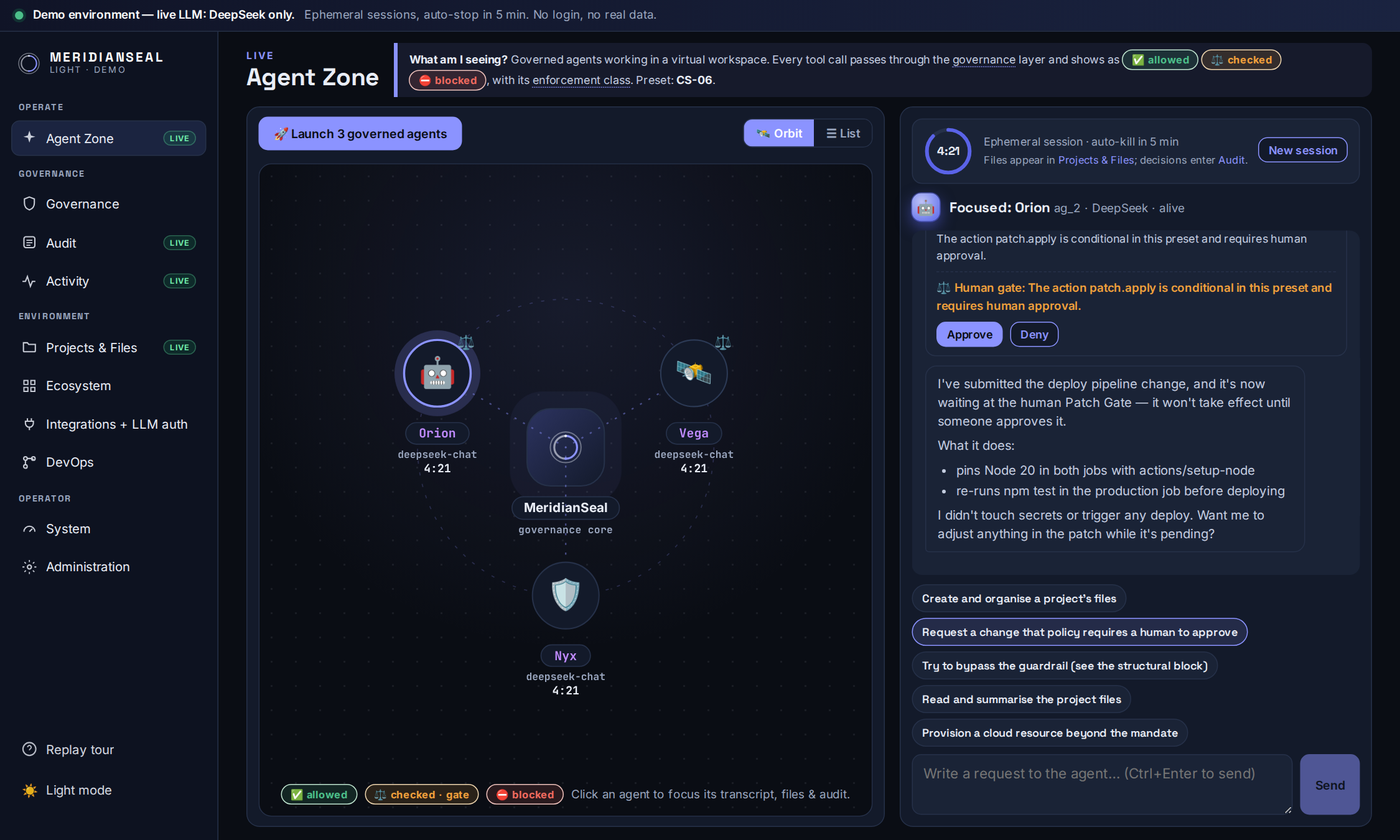
    This site is not only a description of architectural governance – it is a small, working instance of it. MeridianSeal ships as two hosts with one job each, connected only where a job requires it, and it says in public which of its own protections are structural and which are still just watched.

    plane-meridianseal

    The Console

    MeridianSeal’s own control plane – the operator-facing admin console for the reference implementation. It carries no public listener of any kind.

    unisinos-meridianseal

    Showroom, research platform, Launcher

    • This showroom – the public page you are reading now
    • The phdresearch platform – a working instance of the isolated experimental environment specified in D6 §3
    • The Launcher – the single sign-on entry point that authenticates a visitor once and hands them to whichever host their role needs

    Traffic between the two hosts never leaves the private network: the Console has no path reachable from the public internet at all, and the only route from one box to the other is the segmented link between them – the same network-segmentation contract (CB-05, D6 §2) that this framework’s gap analysis is designed to mark not transferable wherever a deployment provides no segmentation between agent workspaces at all. Small as this deployment is, the boundary between its two hosts is drawn on purpose, not inherited as an accident of infrastructure choice.

    Enforced versus monitored, on this build

    Enforced

    A rule the box boundary or the network itself makes true, whether or not anyone remembers to check it – which host is reachable from where, and which of the two needs no public listener at all.

    Monitored

    A rule this build watches and logs but has not yet made unreachable outright – labelled plainly as such, the same way D6 §2 refuses to round a monitored control up to an enforced one.

    The candour is inherited, not decorative. This framework’s own gap analysis (D6 §2) is built to rate most of what looks like a control on a single-host deployment – the policy enforcement point, the egress path, the workload identity – not transferable, precisely because the party each control is meant to bind still holds the means to defeat it. MeridianSeal’s two-host split is a direct, if modest, answer to that finding: keep the boundary honest by drawing fewer of them and enforcing every one you draw.

    Enter the Launcher

    unisinos.meridianseal.com · single sign-on entry point

    The teaser above is deliberately short. The document set behind it is public in full, not summarised away.

    09 — Document set

    The full document set, D0 through D6

    Every claim on this site traces back to one of seven documents, rendered in English and Portuguese from the same machine-readable registers. Nothing here is a marketing summary of them – it is the same text a supervisor and an examining board read. The order below is the suggested reading order, not the document numbering.

    D2Read 2nd

    Supervision and Autonomy Framework

    The spine of the argument: autonomy as a function of guardrail maturity, ten supervision determinants, the irreducible residue, and six viability conditions.

    D3Read 3rd

    Guardrail Catalogue

    A living register of 134 guardrails across twelve layers, each with a bypass analysis and its emitted signal, plus ten experimental condition sets.

    D4Read 4th

    Measurement Framework

    A living register of 72 metrics, each rated for guardrail sensitivity and gaming risk, rolled into eight composite indices.

    D5Read 5th

    Applicability Domains

    Nine domains of activity, each with worked examples and the dimensions that place an action class on the spectrum from instructional to structural.

    D6Read 6th

    Research Environment and Roadmap

    The gap analysis, the reference architecture for an isolated experimental environment, cloud-neutral capability contracts, and a 58-item improvement backlog.

    Citing this work

    Title
    Architectural Governance of Autonomy in Agentic AI Systems
    Candidate
    M.Sc. Epitácio Vicente do Nascimento Neto
    Supervisor
    Prof. Dr. Felipe André Zeiser
    Programme
    Graduate Program in Applied Computing (PPGCA), PhD – University of Vale do Rio dos Sinos (UNISINOS)

    Each document above is versioned and rendered from the same register set in both languages; cite the specific document (D0–D6) and its language edition alongside the credit block above.

    Have a question this document set does not answer directly?

    10 — Contact

    Questions, corrections, collaboration

    Reach the candidate directly – about the research, the guardrail catalogue, or reusing any part of this document set.